The platform
Six things have to happen. This is all six.
Sourcing, qualifying, writing, sending, replying and reporting. Every other tool in this category does one of them well and hands you the other five, which is why teams end up with four subscriptions, three data vendors and nobody accountable for the chain.
- 12
- Scheduled jobs, deliberately separate
- 15 min
- The reactive clock
- 5
- Agents, one per role
- 1
- Path to a person
This week you reached 214 new contacts and received 9 new responses across 3 active campaigns.
Now
In queue now
38
·
Active sequences
412
Sent today
Emails
127
·
Connection requests
18
·
LinkedIn messages
24
Active campaigns
42 sequences running, 10 new this week across 3 senders.
18 sequences running, 6 new this week across 2 senders.
9 sequences running, 4 held for review.
Find, write, send, close, run
Twenty features, and the order is the argument
Grouped by where they sit in the motion rather than by which team built them. If you can only read one group, read the first. Everything downstream is only as good as who is in the list.
Find
Who to talk to, and when they got warm
5 featuresWrite
What to say, in a voice that is yours
3 featuresSend
Out through your own accounts, at a safe pace
4 featuresClose
Every reply, in one place, worked to a call
4 featuresRun it
The team that does all of the above
5 featuresThe runtime
Twelve jobs, and none of them is a loop
Sourcing, queueing and sending are separate ticks on purpose. A bad source then produces a queue you can inspect rather than mail that has already left. The reactive jobs run on the quarter hour in the order the motion runs, so a workspace is never more than fifteen minutes from a send, a reply or a signal match.
| Job | Cadence | What it does |
|---|---|---|
| Roster heartbeat | Every 15 min | Seeds and repairs the five specialists and a coordinator in every onboarded workspace |
| Orchestrator | Every 15 min | Clears stale work, counts parked sends, checks service health |
| Lead sourcing | Daily 08:00 | Resolves the ICP, sizes it, walks up to 200 candidates enriched |
| Signal sweep | Every 15 min | Runs due signals, gates on ICP, enriches before the write |
| Intent monitor | Every 15 min | Raises heat on recent matches, decays silence, watches reactions |
| Queue filler | Every 15 min | Enters warm contacts into the outreach queue, drafting on entry |
| Queue launcher | Every 15 min | Drafts, gates and sends. The only path that contacts a person |
| Reply poller | Every 15 min | Pulls inbound on both channels, stops sequences, dispatches events |
| Quality review | Hourly | Reply rate per step, and whether the list can actually be reached |
| Copy review | 6-hourly | Rewrites the failing step. Does nothing when there is no finding |
| Connection health | 6-hourly | Asks the vendor about each account, resets the counters |
| Retention purge | Daily 03:30 | Deletes what is past its window, batched |
Who runs it
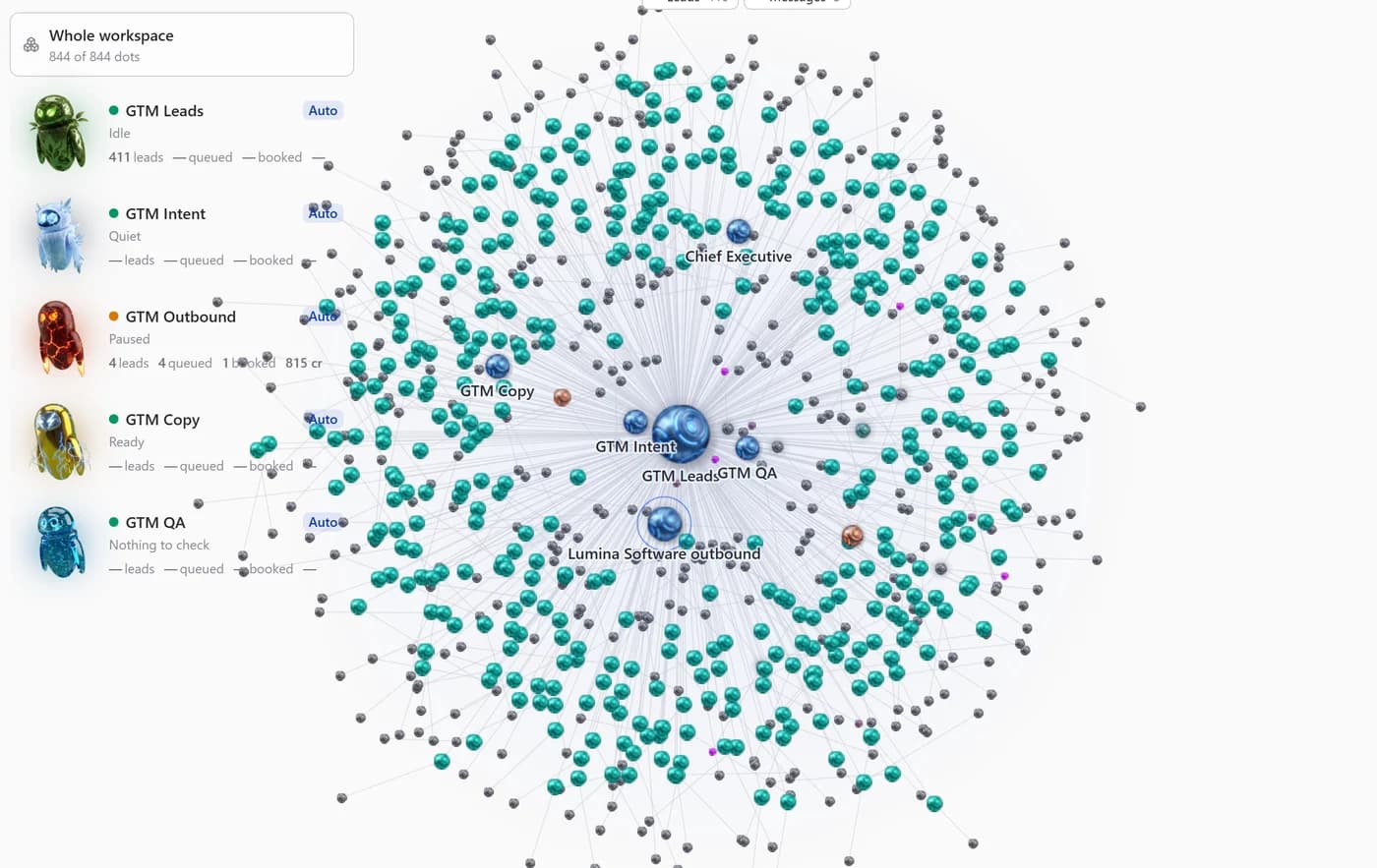
Five specialists and a coordinator, and only one can send
Seeded in every workspace, in a fixed order, addressable by slash command. The outbound agent holds the send tool and nothing else in any belt reaches a person, which is what makes the pre-send gate the single path rather than one of several.
 GTM LeadsDaily
 GTM Intent15 min
 GTM Outbound15 minSends
 GTM CopyOn request
 GTM QAHourly
Everything else
The parts that do not get a page but would have got a subscription
AI copywriting
Written from the evidence that made the lead warm, in your voice
Warmup & deliverability
An enforced ramp, real warmup traffic, and an honest account of its limits
Architecture
Four rules that are not settings
Every one of these is enforced somewhere a bug cannot route around. A database constraint, a transport layer, an allowlist. That is the difference between a guarantee and a preference.
- The gate
- A database constraint, not app logic
- The footer
- Appended by the transport, not the caller
- The belt
- Allowlist, checked twice
- Suppression
- Two scopes, exempt from every purge
- Retention
- Computed from collection, never last-updated
- Operational alerts
- Event codes and identifiers
Everything above, running on your list
Describe the company, confirm the keywords, connect a channel. The agents take it from there, and Supervised mode is available when you want to review before sending.
Start with sales. $2,000 or $5,000 onboarding, then at least $250 monthly credit funding.